
AI Can Create More Content. But Can It Create Better Marketing?
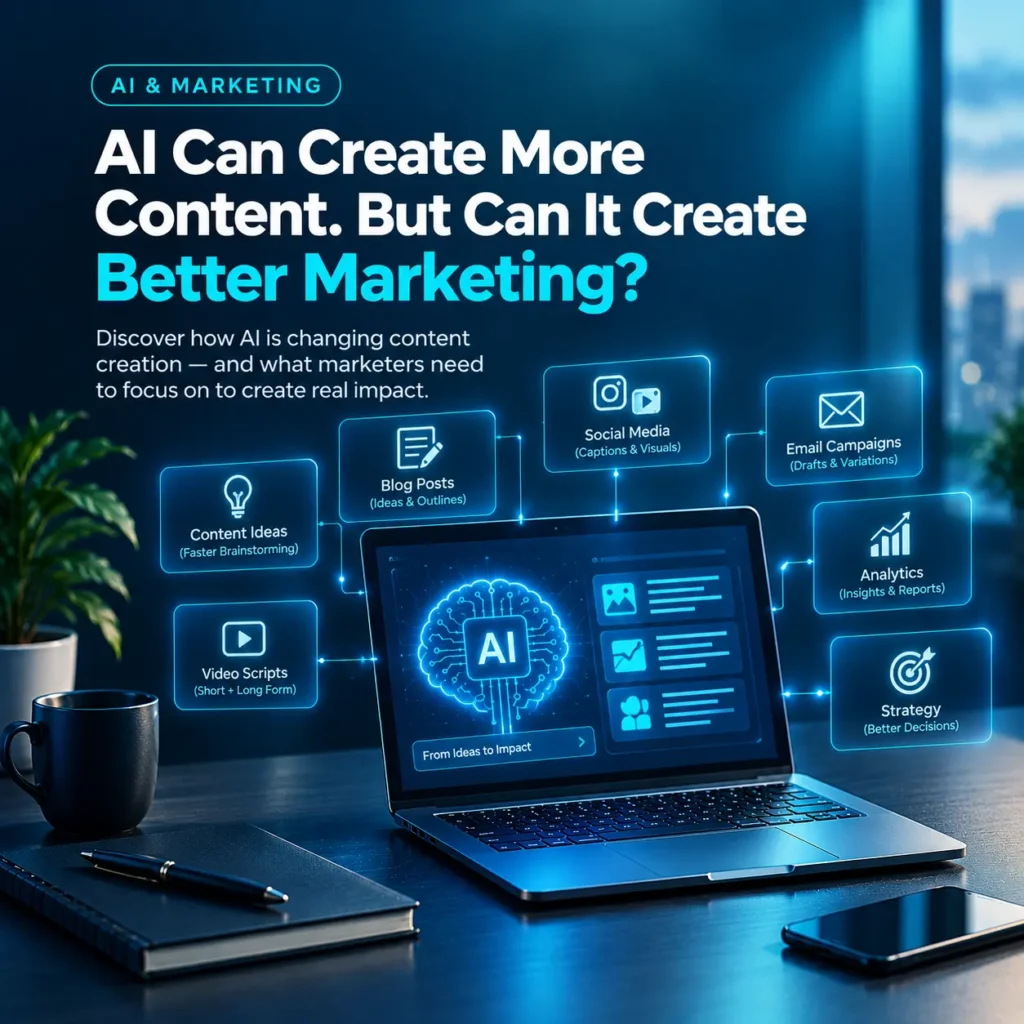
As AI makes content production faster and easier, the real advantage belongs to marketers who understand their audience, think critically, and create content with a clear purpose.
Picture a marketer starting work on a Monday morning. The task list includes a blog post, two weeks of social media captions, a product launch email, three advertising variations, and a short video script.
A few years ago, completing all these tasks might have taken several days. Today, AI tools can help turn that workload into a set of initial drafts in just a few hours.
That is genuinely good news for marketers. AI saves time, supports creativity, and makes content production more accessible.
But it raises an important question: If everyone can create more content, does producing more content still give a brand a competitive advantage?
Not by itself.
From Producing Enough to Creating Something Valuable
For years, one of the biggest challenges in content marketing was consistency. Businesses that regularly published useful content had an opportunity to stand out from competitors who struggled to maintain a schedule.
AI is changing that situation. Producing content consistently is becoming easier, even for small businesses with limited resources.
The challenge is no longer simply about maintaining a steady flow of content. The real challenge is deciding how to create something that people genuinely want to read, watch, remember, and act upon.
Consider what happens when a marketer gives an AI tool a broad instruction such as, “Write a social media post about digital marketing.”
The result may be grammatically correct and professionally structured. It might contain a catchy opening, a few familiar tips, and a concluding call to action.
Yet, the same type of content can be found across countless websites and social media accounts. It communicates information without necessarily giving the audience a compelling reason to remember the brand.
When content follows familiar patterns without adding fresh perspectives, it risks becoming repetitive and predictable.
However, AI-generated content does not have to be generic. When marketers understand their audience, provide a specific brief, and carefully refine the results, AI can support the creation of relevant and engaging content.
The real problem is not using AI to create content. It is publishing content without adding meaningful human judgement.
AI can create more content. But can it create better marketing : A Simple Checklist for Evaluating Content
Before publishing a piece of content, marketers should ask whether it delivers genuine value.
One useful way to think about this is:
Valuable Content = Audience Understanding + Original Insight + Useful Information + Human Perspective + Clear Purpose
Let’s examine each element.
Audience understanding
Who is the content intended for? What problem are they facing? What questions are they trying to answer?
Content becomes more relevant when it reflects the audience’s actual needs rather than the marketer’s assumptions.
Original insight
What does this content contribute to the conversation? Does it offer a fresh observation, a useful comparison, a practical lesson, or a different way of understanding a familiar problem?
Originality does not always require inventing something entirely new. Sometimes, it means explaining an existing idea through a valuable perspective or real experience.
Useful information
Will the reader learn something, make a better decision, or know what to do next?
A piece of content should provide more than words to consume. It should offer something the audience can use.
Human perspective
Does the content reflect genuine experience, informed judgement, or a meaningful point of view?
Personal observations, customer stories, professional experience, and carefully considered opinions can help distinguish one brand from another.
Clear purpose
Why does this content exist? Is it designed to educate, build trust, generate enquiries, encourage a purchase, or strengthen brand awareness?
When the purpose is unclear, even well-written content can struggle to deliver meaningful results.
Imagine a bicycle repair shop planning a blog post.
A general article titled “Tips to Maintain Your Bicycle” might offer useful information, but many competing websites already cover the same subject.
The shop could take a more specific approach by explaining how Kerala’s monsoon affects bicycle chains and describing the maintenance checks its mechanics recommend during the rainy season.
If those recommendations come from the shop’s actual experience, the content can offer something more distinctive: local relevance, practical expertise, and a reason for potential customers to trust the business.
This is where a brand can create value beyond simply publishing another article.
If a draft lacks audience relevance, original thinking, and practical usefulness, polishing its sentences alone will not solve the problem.
Who Is Really Steering the Marketing Process?
AI can generate content quickly, but the way marketers use it determines whether that speed leads to meaningful results.
Consider two different workflows.
Workflow 1: Content production
Prompt > AI generates content >Publish
This process prioritises speed. The marketer gives an instruction, receives an output, and publishes it with little additional thought.
Workflow 2: Strategic content creation
Understand the audience, Research the problem, Develop an insight, Define the strategy, Use AI for assistance, Edit and verify, Publish, Measure results, Improve
The second workflow takes more planning, but each stage serves a purpose.
- Audience research helps prevent irrelevant content.
- Original thinking reduces the risk of producing something interchangeable with competitors’ work.
- Clear direction helps AI generate more suitable drafts.
- Human editing improves tone, clarity, and brand consistency.
- Fact-checking helps identify inaccurate claims.
- Performance measurement reveals what resonates with the audience and what needs improvement.
AI can assist at several stages, but it should not automatically determine the strategy.
Think of AI as the engine that helps move the work forward. The marketer still needs to choose the destination and decide which direction to take.
Working Alongside AI, Not Depending on It
AI tools can support many everyday marketing activities, including brainstorming, research assistance, outlining, drafting, repurposing content, summarising information, analysing data, and creating variations for different platforms.
However, the marketer remains responsible for understanding the business, defining its positioning, interpreting customer needs, checking accuracy, and deciding whether the final output is appropriate.
The distinction is not that humans should do everything while AI does very little. The better approach is to give each task the right balance of automation and human judgement.
For example, a marketer could ask AI to identify weaknesses in a campaign idea, suggest alternative headlines, or review a draft for unclear explanations.
The marketer can then evaluate those suggestions against actual customer insights, business goals, and the brand’s identity.
One useful way to think about AI is as a knowledgeable assistant that can process information and generate ideas but does not automatically possess firsthand experience of your customers.
It can help you prepare for a customer conversation. It cannot replace the value of genuinely listening to that customer.
Five Habits Every AI-Driven Marketer Should Build
Using AI effectively requires more than learning which buttons to click or which prompts to copy. It requires habits that improve the quality of the thinking behind the output.
Begin with the audience, not the tool.
Before opening an AI application, write down who the content is for, what problem it addresses, and what the reader should gain from it.
Give AI a clear brief.
Treat the tool like a new colleague. Explain the audience, objective, context, tone, format, and limitations. A detailed brief gives the tool a better chance of producing relevant material.
Add your own perspective.
Bring in your observations, experiences, examples, and opinions. AI can help you express an idea, but your own understanding should shape what you want to communicate.
Review the output critically.
Check facts, names, dates, statistics, and references. Then go beyond accuracy and ask whether the content is genuinely useful or simply sounds convincing.
Measure impact, not just output.
Publishing more posts does not automatically mean achieving better marketing results. Look at relevant measures such as meaningful engagement, qualified enquiries, conversions, and audience feedback.
Five useful pieces of content that help people understand a brand may be more valuable than fifty posts that receive little attention and produce no meaningful action.
The right measurement depends on the content’s purpose.
What should Beginners Learn as AI Becomes More Common
AI tools are evolving quickly. A particular platform or feature may become less relevant over time, but the underlying marketing skills remain valuable.
For beginners entering digital marketing, several areas deserve attention:
- Marketing fundamentals: Understand customer needs, positioning, value propositions, and the role of marketing in business growth.
- Consumer psychology: Learn how people recognise problems, evaluate options, build trust, and make decisions.
- AI literacy: Understand how to brief AI tools, evaluate their outputs, and use them responsibly.
- Critical thinking: Question assumptions, identify weaknesses, and distinguish credible information from unsupported claims.
- Creativity and storytelling: Learn to communicate ideas in ways that are relevant, memorable, and appropriate for the audience.
- Communication: Develop clear writing, listening, presentation, and collaboration skills.
- Strategy and analytics: Connect marketing activities to business objectives and use performance data to improve decisions.
- Brand understanding: Recognise what makes a business different and how its communication should reflect that identity.
Beginners do not need to master every skill immediately. A stronger approach is to build the fundamentals, practise with real projects, and gradually learn how to combine AI tools with sound marketing judgement.
As content production becomes easier, thoughtful decision-making becomes more important. Speed is one area where machines can provide a major advantage, so marketers should avoid competing on speed alone.
Instead, they should learn to use that speed to create more relevant, effective, and meaningful work.
A Practical Framework: Think to Learn
To put these ideas into practice, consider this seven-stage workflow for creating and improving content.
THINK : Define the purpose.
Identify the target audience, the problem to address, and the outcome you want the content to achieve.
RESEARCH : Understand the situation.
Explore audience questions, examine relevant sources, and identify gaps in existing content. Verify important information before using it.
DIRECT : Set the direction.
Turn your findings into a clear brief. Specify the intended audience, key message, tone, format, and desired action.
CREATE : Develop the material.
Use AI to explore ideas, generate draft versions, or test alternative approaches. Treat its output as working material rather than a finished product.
EDIT : Add judgement and originality.
Improve the structure, strengthen the argument, incorporate relevant experience, and correct inaccuracies. Make sure the content reflects the brand’s voice and serves the audience.
TEST : Observe the response.
Publish the content with a clear objective. Depending on the format, measure engagement, enquiries, conversions, or other relevant indicators.
LEARN : Use the evidence.
Study the results, identify what worked and what did not, and apply those lessons to the next planning stage.
The process then returns to THINK, informed by what the marketer has learned.
AI can assist throughout this workflow, but its greatest contribution may be helping marketers explore possibilities and complete tasks more efficiently. Defining the right problem, choosing what matters, and interpreting the results still require human judgement.
Back to the Question
If everyone can create more content, what will make one marketer or brand stand out from the rest?
It probably will not be volume alone.
The advantage may belong to the marketer who understands the audience more deeply, identifies problems worth solving, develops meaningful insights, and knows how to use AI to communicate those insights effectively.
AI has lowered the barrier to producing content. That creates opportunities for businesses, individuals, and new marketers who previously lacked the time or resources to compete.
But access to a tool does not guarantee the ability to use it well.
Anyone can now fill a page with words. Creating something that deserves attention requires a different level of thinking.
The marketer who stands out will not simply know how to create content. They will know why it matters, whom it serves, and what it should achieve.
FREE CONSULTATION WITH A MARKETING CONSULTANT
CONTACT NOW
Have an Idea? Let’s Talk.
Whether it’s a marketing project, collaboration, a new opportunity, or simply an interesting idea, I’m always open to meaningful conversations.
Services
Digital Marketing
Content Strategy
Web & Digital Experiences
AI-Powered Marketing