
Inbound vs Outbound Marketing: What’s the Difference?
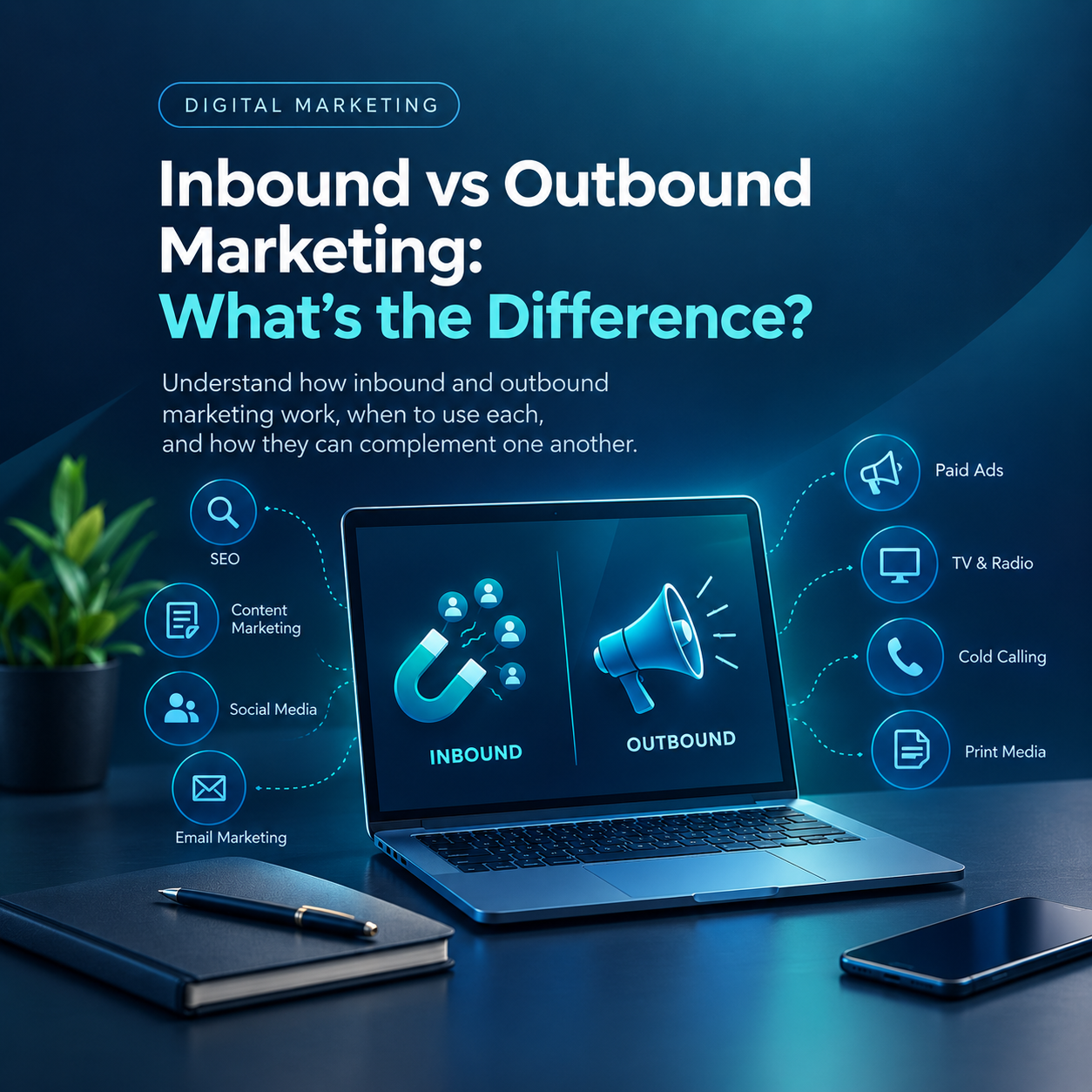
Understand how inbound and outbound marketing work, when to use each, and how they can complement one another.
Every business needs to reach people. But the way a brand reaches its audience can make a huge difference.
Some businesses attract potential customers by creating useful content, answering questions, improving their search visibility, and building relationships over time. Others actively place their message in front of people through advertisements, cold outreach, direct promotions, or traditional media.
These approaches are commonly described as inbound marketing and outbound marketing.
Inbound marketing focuses on attracting people toward a brand, while outbound marketing involves proactively taking a message to potential customers.
But the difference isn’t simply:
Inbound = good
Outbound = bad
Both approaches have their place. The right choice depends on the business, audience, objectives, budget, buying journey, and available resources.
In this article, let’s understand what inbound and outbound marketing actually mean, how they differ, and how businesses can use them together.
What Is Inbound Marketing?
Inbound marketing is a strategy focused on attracting people by providing content, experiences, and information that are useful and relevant to them.
Instead of immediately interrupting someone with a promotional message, inbound marketing tries to become useful before asking for the customer’s attention, trust, or business.
For example, imagine someone searching Google for:
“How to choose the right digital marketing course?”
A training institution could create a helpful article answering that question.
The person discovers the article through search, reads it, explores the website, watches related content, and eventually becomes interested in the institution’s programs.
The organization didn’t necessarily chase the person.
The content attracted them.
That’s the basic idea behind inbound marketing.
Common inbound marketing channels
Inbound marketing can include:
- Search Engine Optimization (SEO)
- Blog articles
- Educational videos
- Social media content
- Email newsletters
- Guides and ebooks
- Webinars
- Podcasts
- Case studies
- Useful resources
- Community building
The central principle is simple:
Create value that attracts the right audience.
What Is Outbound Marketing?
Outbound marketing involves proactively putting a marketing message in front of potential customers.
Instead of waiting for someone to discover the brand, the business actively reaches out.
For example, a company may run a Facebook or Instagram advertisement targeting people who match its desired audience.
Other examples include:
- Paid advertising
- Cold emails
- Direct sales outreach
- Telemarketing
- Display advertising
- Sponsored promotions
- Direct mail
- Traditional television or radio advertising
- Promotional campaigns
Suppose a new restaurant opens in a city.
Instead of waiting for people to search for it, the restaurant might run social media advertisements targeting people living nearby.
That is an example of outbound marketing.
Inbound vs Outbound: The Core Difference
The easiest way to understand the distinction is to think about direction.
Inbound
Audience → Brand
The audience discovers, engages with, and moves toward the brand.
Outbound
Brand → Audience
The brand actively takes its message to potential customers.
This doesn’t mean that inbound always happens slowly or outbound always happens quickly. The real difference is the method of initiating attention.
The Role of Content in Inbound Marketing
Content is one of the strongest foundations of inbound marketing.
But content marketing isn’t simply about producing large amounts of content.
The real question is:
Does this content help the audience solve a problem, answer a question, or make a decision?
For example, a software company could create:
- “How to choose project management software”
- “Project management checklist”
- “How to manage a remote team”
- “Common project management mistakes”
These resources can attract people who are already interested in the problem the company solves.
This is where inbound marketing connects naturally with SEO.
Someone searches for a problem.
The brand provides a useful answer.
The person discovers the brand.
Trust begins to develop.
Eventually, that person may become a lead or customer.
The Role of Advertising in Outbound Marketing
Outbound marketing becomes particularly powerful when a business needs to reach a specific audience quickly.
For example, suppose an educational institution is launching a new course and wants applications within the next few weeks.
It could use paid advertising to reach people based on factors such as:
- Location
- Interests
- Demographic characteristics
- Previous interactions
- Online behavior
Advertising can provide reach and speed that organic content may take longer to achieve.
However, paid reach doesn’t automatically mean successful marketing.
The advertisement still needs:
The right audience + the right message + the right offer + the right landing experience.
When Should You Use Inbound Marketing?
Inbound marketing can be particularly useful when your goal is to build long-term visibility and trust.
Consider inbound when you want to:
- Build organic search traffic
- Establish authority around a topic
- Educate potential customers
- Build a content library
- Develop a community
- Generate leads over time
- Create long-term brand visibility
For example, a consulting business could publish helpful articles for months or years. Those articles may continue attracting relevant visitors through search and social sharing.
Inbound is therefore often an asset-building approach.
When Should You Use Outbound Marketing?
Outbound can be useful when speed, reach, or targeted distribution is important.
Consider outbound when you want to:
- Launch a product
- Promote a time-sensitive offer
- Reach a new audience quickly
- Generate immediate awareness
- Support an event
- Drive traffic to a specific landing page
- Test different audiences and messages
Paid advertising can also help marketers learn which audiences, offers, and messages generate the strongest response.
Why Choosing Only One Can Be a Mistake
One of the biggest mistakes marketers can make is treating inbound and outbound as competitors.
They can actually support each other.
Imagine a company publishes a detailed blog article.
That’s inbound.
The company then runs a paid advertisement promoting that article to a carefully selected audience.
That’s outbound.
The advertisement brings more people to the content.
Some of those visitors discover the brand.
Some may subscribe.
Some may eventually become customers.
The two approaches have worked together.
A Practical Example
Imagine an educational institution wants to increase applications for a new program.
Inbound approach
The institution could create:
- SEO-friendly articles
- Student success stories
- Educational Instagram content
- YouTube videos
- Course guides
- FAQs
- Student testimonials
People searching for information discover these resources.
Outbound approach
The institution could also run:
- Instagram advertisements
- Facebook campaigns
- Google Ads
- Promotional email campaigns
- Direct outreach
These campaigns actively reach potential students.
Combined strategy
The strongest approach could be:
Content → Search/Social Discovery → Paid Promotion → Website → Lead → Follow-up → Application
This is much closer to how modern marketing actually works.
The Important Question: Which One Is Better?
There isn’t a universal answer.
A better question is:
Which approach is appropriate for this particular marketing objective?
If you’re trying to build long-term organic visibility, inbound may play a major role.
If you’re launching something and need immediate attention, outbound may be valuable.
If you want both sustainable visibility and faster distribution, combining them may make more sense.
Final Thoughts
Inbound and outbound marketing represent two different ways of reaching an audience.
Inbound attracts. Outbound reaches.
Inbound marketing can help businesses build trust, authority, content assets, and organic visibility. Outbound marketing can help businesses achieve targeted reach, generate awareness, and support time-sensitive campaigns.
The smartest strategy isn’t necessarily about choosing one side.
It’s about understanding where your audience is, what they need, how they make decisions, and which marketing channels can help move them toward the desired action.
Good marketing isn’t simply about getting attention.
It’s about getting the right attention from the right people at the right time.