
How AI Is Changing Digital Marketing:
What Marketers Need to Learn in 2026
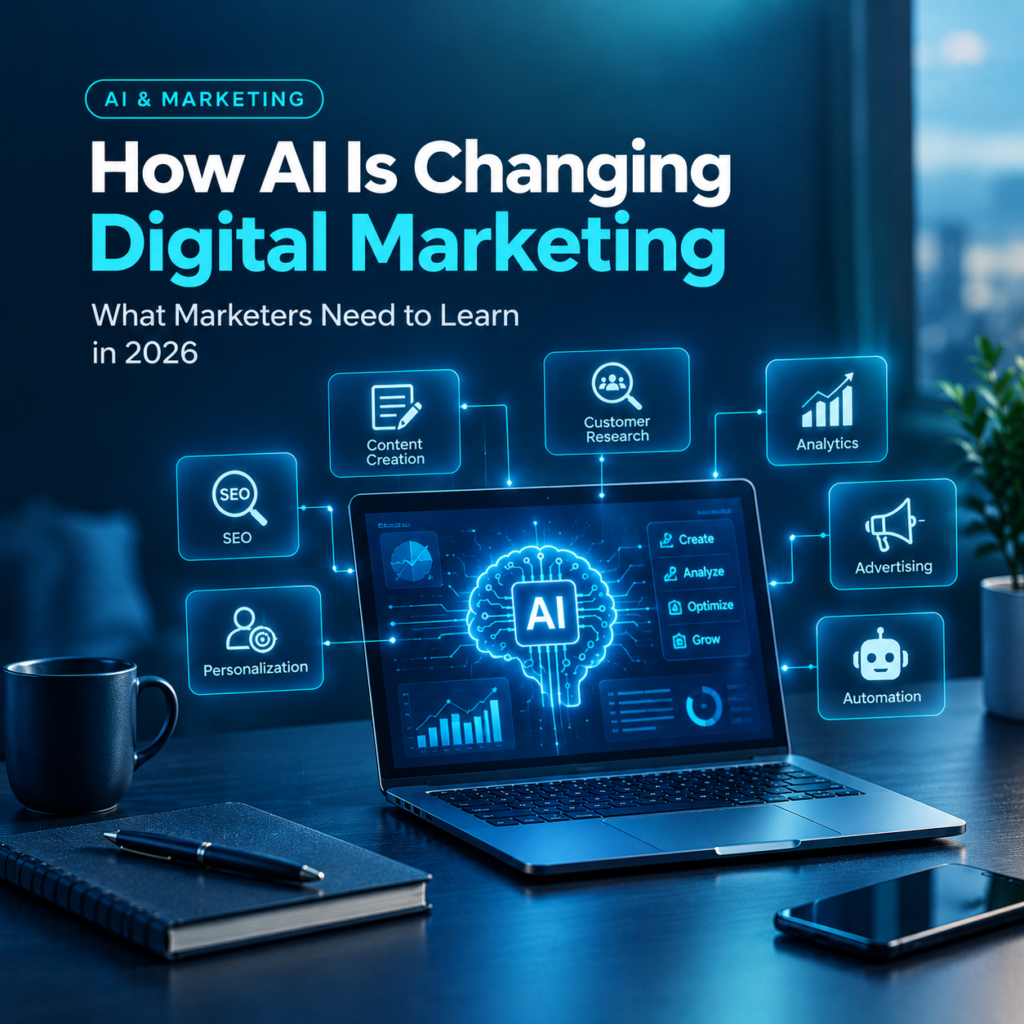
Marketing teams now use AI to research keywords, draft emails, test ads and summarise reports. For a beginner, this raises an uncomfortable question: if software can do all that, is there still a place for a human marketer?
This article argues that there is, but the job is changing.
AI in digital marketing speeds up execution. It does not decide what is worth
doing. That makes strategy, judgement and audience understanding more valuable,
not less.
What AI Has Changed
In the past, digital marketing took a long time for research and creating content.
It could take days to study competitors, write different ad versions, or put together a report.
Using AI helps speed up these tasks in four ways:
Speed: First drafts and summaries come much quicker, often in just a few minutes.
Scale: One person can now test more ideas than ever before.
Personalisation: Messages can be tailored to different groups of people more easily.
Analysis: Big amounts of data can be sorted and summarized faster than before.
Just because something is done faster doesn’t mean it’s better marketing. The main challenge has shifted from making the work to deciding which ideas to use and checking them.
Where AI Is Used in Digital Marketing
AI for SEO
SEO stands for search engine optimisation, and it’s about getting your website to show up in search results without paying for it.AI can help you with a lot of the setup. It can organise a long list of keywords into
main topics, create a structure for your webpage, and show you what other pages are covering that your page isn’t. For technical stuff, it can help you spot duplicate page titles or even write the first draft of structured data, which is the code that helps search engines understand what your page is about.
One common mistake that new people make is not thinking about the searcher’s goal. For example, someone searching for “standing desk” might just be looking to browse products, while someone searching for “standing desk for back pain” is probably looking for help and advice before buying. AI can make an educated guess about this, but you can check it yourself. Try searching the phrase, then look at the first few results. Are they product listings,
comparison pages, or how-to guides? That will tell you what people and search engines are expecting.
Search results are also changing because AI-generated answers are starting to appear above regular links.
How much this affects clicks depends on the search and can change over time, so it’s a good idea to check the latest search engine updates before making any big decisions. For now, the safest way is to write clear answers to questions
and show that you really know what you’re talking about.
AI Content Marketing
AI content marketing works well for topic research, outlines, repurposing a webinar into a newsletter, and tidying drafts. The risk is sameness. If everyone asks a tool for “a blog on email marketing tips,” the results look alike. Content that includes your own examples, data or opinions stands apart.
Social Media Marketing
AI can suggest post ideas, draft captions, summarise audience comments and show which formats perform best. A small café, for example, could use it to plan a month of posts. A human still decides which one’s sound like the café.
Paid Advertising
Ad platforms already use AI to adjust bidding and targeting. Marketers can add to this by generating several headline variations and testing them against each other. The platform reports which version won. Deciding what to test, and why, remains your job.
Marketing Analytics
AI can summarise dashboards, flag unusual drops in traffic and suggest possible explanations. Treat those explanations as hypotheses, not conclusions. A traffic drop might come from a tracking error, a seasonal pattern or a real problem, and someone must investigate.
What AI Cannot Replace
AI can produce creative ideas, strategic suggestions and emotional language. The difference lies in responsibility. A tool can generate options, but it does not carry the consequences of a campaign.
Strategy: choosing which goals matter for this business, this year. Brand judgement: knowing when a message feels off, even if it is technically correct.
Cultural context: understanding humour, sensitivities and local meaning. A phrase that works in one market can fail in another.
Critical thinking: questioning an output instead of accepting it.
Communication: persuading a client, explaining a result, building trust.
Think of AI as a capable assistant. You are still the person who signs off the work.
The New Role of the Marketer
Marketers are shifting from doing every task by hand to directing a process. In practice this means acting as a strategist who sets direction, a creative director who shapes tone, an analyst who checks the numbers, and a decision maker who chooses what goes live.
Skills Worth Building
Marketing skills: fundamentals, consumer psychology, SEO, copywriting, analytics and conversion optimisation (improving the share of visitors who take an action).
AI-related skills: writing clear prompts, designing repeatable workflows, using AI for research, and interpreting data it produces.
Human skills: critical thinking, communication, creativity, problem solving and adaptability.
Learning tools without marketing fundamentals is not enough. If you cannot judge a good headline or a sound strategy, you cannot tell when the tool is wrong.
A Practical Workflow for Beginners
· Marketing objective: define one clear goal, such as more newsletter sign-ups.
· Audience research: talk to customers, read reviews, study comments.
· AI-assisted research: use AI to organise findings and suggest questions.
· Strategy: decide the message, channel and offer yourself.
· AI-assisted execution: draft copy, outlines or variations.
· Human review: edit, fact-check and match your brand voice.
· Launch: publish with a plan to track results.
· Measurement: compare results with the original goal.
· Optimisation: keep what worked, change what did not.
Common Mistakes
· Publishing AI output without editing or factchecking
· Using AI before understanding the audience or objective
· Choosing quantity over quality
· Ignoring brand voice
· Relying on AI for decisions you should own
· Assuming AI knowledge alone makes someone a marketer
Future of Digital Marketing
The future of digital marketing will likely bring more AI-assisted workflows, more automation of routine tasks and more personalisation. It will also bring more competition among generic content, since anyone can produce it. In that environment, original insight, real expertise and a recognisable voice become the differentiators. These are directions to watch, not guarantees.
Conclusion
AI is changing how marketing work gets done, not why it matters. Tools will keep improving, but they still need someone who understands people, sets direction and takes responsibility. The marketers who do well will be those who pair strong fundamentals with sound judgement, and who treat AI as a way to think and work better, not as a substitute for either.
FREE CONSULTATION WITH A MARKETING CONSULTANT
CONTACT NOW
Have an Idea? Let’s Talk.
Whether it’s a marketing project, collaboration, a new opportunity, or simply an interesting idea, I’m always open to meaningful conversations.
Services
Digital Marketing
Content Strategy
Web & Digital Experiences
AI-Powered Marketing